What Is a Fond?
A fond (plural: fonds) is the top-level grouping in archival arrangement. It's the body of records created or accumulated by a single person, family, organisation, or institution.
Fonds reflect the foundational archival principle of provenance — keep together records that came from the same source, and don't mix them with records from elsewhere.
In the sidebar the feature appears as Catalogue, under HOLDINGS.
Fonds and Dossiers are available on Starter and above. Community-tier accounts can use Accessions, but not the Fonds hierarchy.
The hierarchy
Archivers.ai supports the full ISAD(G) hierarchy:
Fond
└── Sub-fond
    └── Section
        └── Sub-section
            └── Series
                └── Sub-series
                    └── Sub-sub-series
                        └── Accession (the batch you uploaded)
                            └── Item (the individual file)
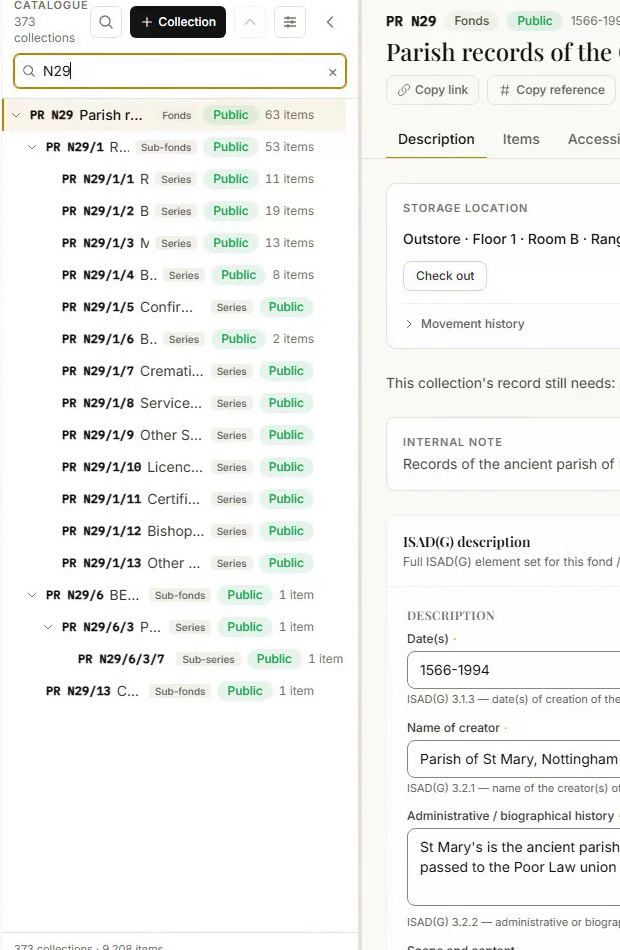
You don't have to use every level. A common simple structure is just Fond → Series → Accession. Use sub-fonds when a fond has clear internal divisions (e.g. a company's records split by department). Use section and sub-section for large classifications with outer groupings (e.g. parish records organised by topic area). Use sub-sub-series for additional fine-grained divisions below sub-series.
How fonds differ from dossiers
| Fonds | Dossiers | |
|---|---|---|
| Organising principle | Provenance (who created the records) | Subject (what they're about) |
| Stability | Permanent — reflects the archive itself | Flexible — created for a research project, exhibition, or enquiry |
| Granularity | Coarse — a fond can contain thousands of items | Fine — typically tens to hundreds of items |
| Items can belong to | Exactly one place in the hierarchy | Multiple dossiers simultaneously |
Use fonds for your archive's permanent structure. Use dossiers for thematic research that cuts across the structure.
When you might not want fonds
If you're a community group with a small, single-collection archive (a village history group with one collection of photos, say), you might find fonds unnecessary — every accession sits at the same level, and the hierarchy adds no value. Fonds shines when you're managing multiple collections from multiple creators.
What fonds enables
- Collective description at every level — every level of the hierarchy, not just the top fond, has its own full set of ISAD(G)/DACS collective description fields (scope and content, biographical/administrative history, and the rest) — a series or sub-series can carry its own description independently of its parent.
- Nested multilevel finding aids — the EAD3 export is a genuine nested multilevel document reflecting the whole structure you've built, from fond down through sub-series, so other archivists can navigate it exactly as arranged.
- Faceted search — filter results by fond on the Search page.
- Inheritance — descriptions and rights at the fond level cascade to children, reducing duplication.
- Reportability — usage and storage roll up by fond, useful for accountability and grant reporting.
See also
- Creating your structure
- Assigning accessions
- Importing a structure — bring in an existing CSV or EAD3
- Setting up storage locations — record where the physical material for a fond or series lives
- Publishing, scheduling, and unpublishing — publish a fond and its descendants to the Public Portal