What Is an Authority?
An authority is a controlled value for a subject, person, place, or organisation — one that resolves to a URI in a published vocabulary. When you describe a photograph as being about Derby County Football Club, you can use the string "Derby County Football Club", or you can use the authority record with the FAST URI http://id.worldcat.org/fast/532119.
Archivers.ai does both — every entity the AI extracts is offered the chance to be linked to an authority. This unlocks faster cross-collection discovery, machine-readable subject access, and round-tripping into systems that speak the same vocabularies.
The vocabularies Archivers.ai links to
| Vocabulary | What it covers | Example |
|---|---|---|
| LCSH | Library of Congress Subject Headings — broad subject terms | "Football—England—Derby" |
| FAST | Faceted Application of Subject Terminology — refined LCSH | "Derby County Football Club" |
| Getty AAT | Art & Architecture Thesaurus — object types, materials, techniques | "figurines", "resin" |
| Getty TGN | Thesaurus of Geographic Names — places, historical and current | "Derby (Derbyshire, England)" |
| VIAF | Virtual International Authority File — people and organisations | "Bloomer, Steve, 1874–1938" |
| GeoNames | Geographic features, populated places | "Pride Park Stadium" |
| Wikidata | Pan-disciplinary entities | Q14910 (Derby County F.C.) |
| Getty ULAN | Union List of Artist Names — makers | "Wright, Joseph, 1734–1797" |
| Getty CONA | Cultural Objects Name Authority — named works | a named painting or monument |
| Iconclass | Iconographic subjects in art | "landscapes with figures" |
| MeSH | Medical Subject Headings | "Public Health" |
| FISH | Historic England thesauri — monument types, periods, building materials, maritime craft | "mill", "Victorian" |
Anything that isn't in one of these — a local family, a parish group, the village club — becomes a local authority of your own, tagged LOCAL on screen.
The full source list with attribution is on the marketing site's Sources page.
Why it matters
Cross-collection discovery
Search for "Derby County FC" by authority (clicking the pill) and you get every appearance of that subject across every accession, fond, and dossier — regardless of how the term was written in the original material. Free-text search can't do this.
Standards-compliant export
Every authority-linked field carries its URI into EAD3, Dublin Core, ArchivesSpace, and AtoM exports. Receiving systems can map straight onto their own authority records — no manual reconciliation.
Discovery beyond your archive
National aggregators and academic search platforms link on these URIs. Authority-linked records in your finding aid become findable on Archives Portal Europe, Wikidata-linked institutional dashboards, and library discovery interfaces.
Where you see authorities
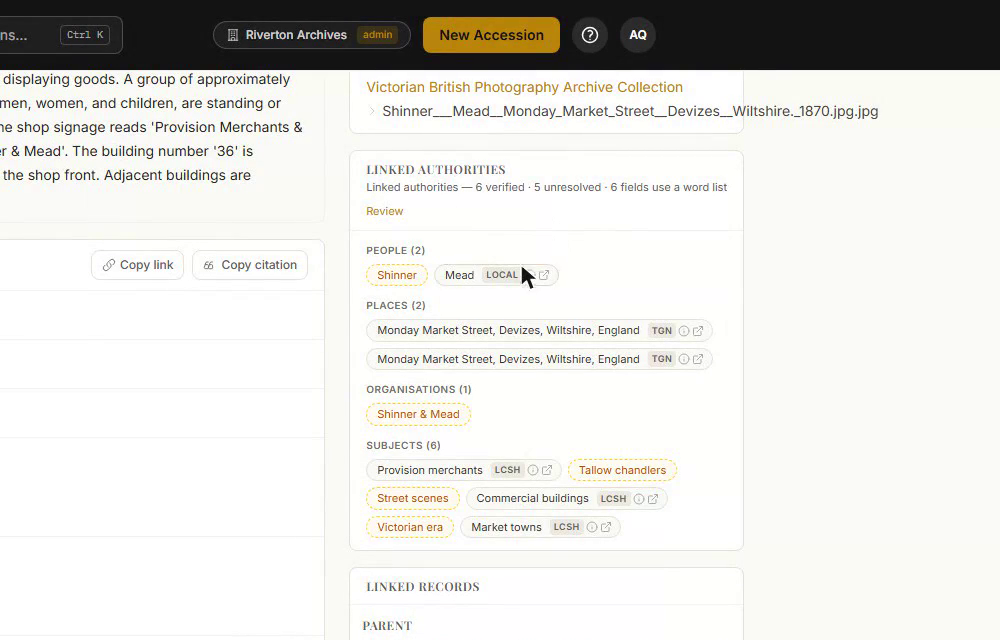
- As pills on item cards — both on the item review screen and in search results
- On the Authorities tab of each accession — verified, unresolved, and needs-review groups
- In the Authority Control workbench — org-wide view of all unresolved and linked entities, with tools to link in bulk and merge variants
- In Data Model — fields can be bound to one or more vocabularies, controlling which sources are queried during processing
The verification cycle
When the AI suggests an authority, the link is initially Unresolved — a candidate the model proposes. You settle it on the Authorities tab, and the badge on the entity tells you where it stands:
| Badge | Meaning |
|---|---|
| Needs review | The model is uncertain or has conflicting candidates |
| Unresolved | A candidate has been proposed but nobody has settled it |
| Approved | A person has confirmed the link |
| Auto-linked | The model linked it without asking, under your linking posture |
| Local | Linked to one of your own local authorities |
| Set aside | Deliberately not linked — a street address, a date, a reference number |
The Authorities tab groups the first three under Needs review and Unresolved, and the rest under Verified.
See Reviewing authorities for the workflow.
What's next?
- Reviewing authorities — accepting, rejecting, and editing the AI's proposals within an accession
- Managing authorities — org-wide authority linking, merging variants, and configuring linking settings
- Applying domain packs — turning on bulk vocabulary bindings for a specific subject area