Asking Good Questions
Research & Explore is at its best when you give it specific, well-shaped questions. Here's what works, what doesn't, and a few patterns to copy.
What works
Be specific
Vague questions get vague answers.
| Less useful | More useful |
|---|---|
| Tell me about Derby County. | Who was the chairman of Derby County between 1955 and 1972, and what major decisions are recorded? |
| What's in this archive? | What are the date ranges, dominant categories, and main institutional creators represented in this archive? |
Ask one thing per question
Compound questions confuse the model. Break them up.
| Compound | Single |
|---|---|
| Who was X and when did they leave and what did they do after? | Three separate questions; the second and third can build on the first. |
Ask for evidence
End with "with citations" or "quote the source" to nudge the model toward direct quotation.
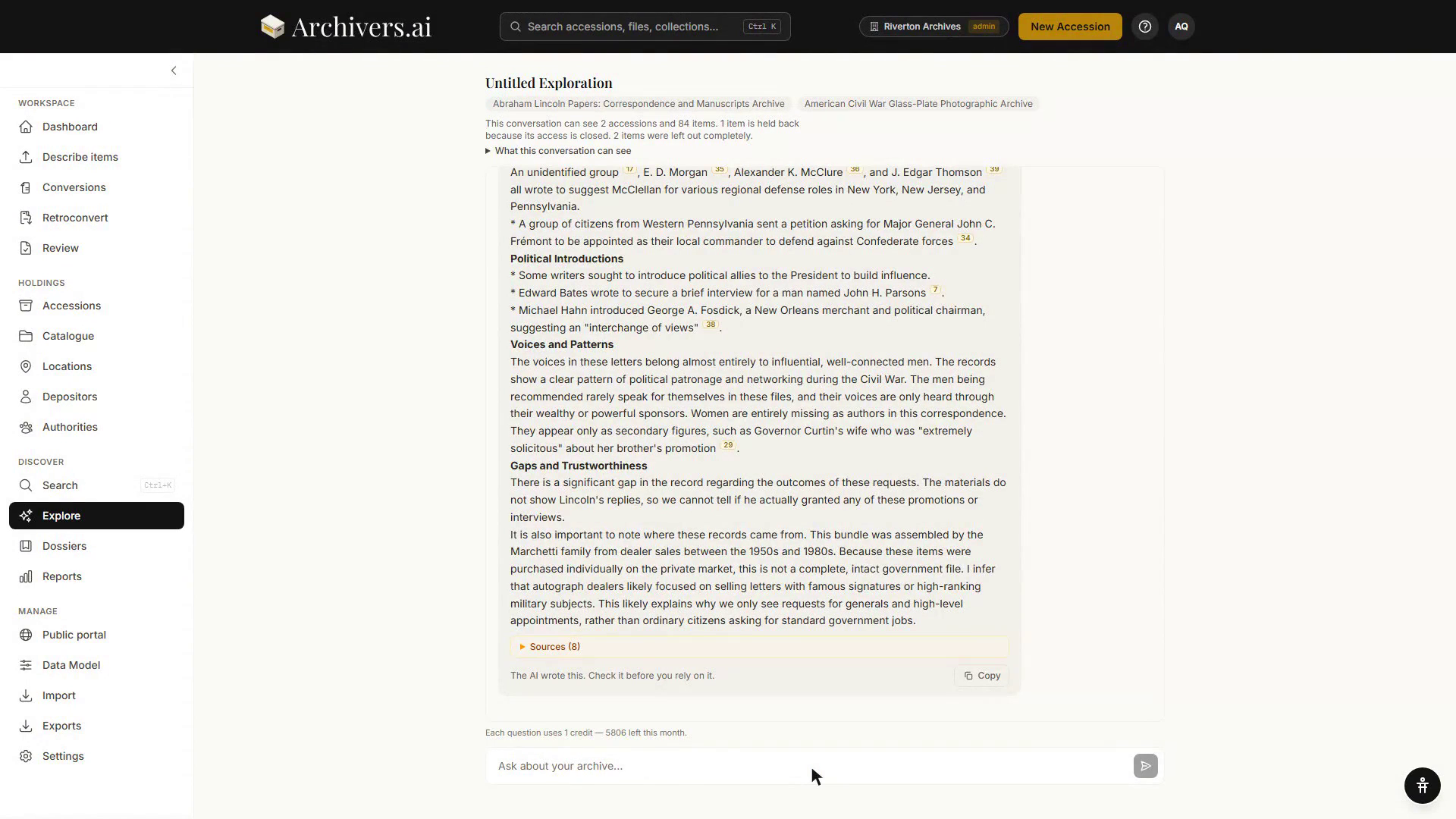
Ask about absences
Often more informative than asking about what's present.
- "Are there years between 1880 and 1920 where no records exist for the Thornton family?"
- "Which trustees named in the 1956 minutes never appear again?"
- "Is there any record of how X was funded?"
Follow up
The first answer rarely lands the question fully. The follow-up — "Drill into 1962" — is where the value is.
What doesn't work
Out-of-archive questions
The model only knows what you've uploaded. "What was happening in the UK in 1956?" will get "I don't have material covering that question, but in your archive there are several items from 1956 mentioning…" — which may or may not be useful.
Counterfactuals
"What would have happened if X hadn't resigned?" isn't a question the archive can answer. The model will either decline or speculate.
Statistical claims that require complete coverage
"How many tenants of the Thornton estate were illiterate?" can only be answered if the archive contains evidence on every tenant. If coverage is partial, the answer will be partial — and you should treat it as such.
Ambiguous proper nouns
"Smith" without context will turn up dozens of Smiths. Disambiguate up front: "John Smith the engineer, not the solicitor."
Useful question types
Factual
- Who founded the company, and when?
- What was X's role in Y between 1956 and 1962?
Relational
- Who else is named alongside Mary Thornton in these letters?
- Which trustees overlap between the 1962 board and the 1965 board?
Chronological
- Construct a timeline of meetings at which the Smith case was discussed.
- List every recorded date X is mentioned, in order.
Thematic
- What themes emerge from the photographs in this dossier?
- Summarise the development of housing policy in this fond.
Comparative
- How does the 1962 board's stance on procurement differ from the 1965 board's?
Gap-finding
- Identify years with no surviving records.
- Which letters from this exchange are missing replies?
Source-tracing
- Find every mention of "the Mitchell scheme" and group them by year.
- Quote the three earliest mentions of "Derby County Football Club" in this archive.
Iterating
Treat Explore like a research conversation, not a database query.
- Open broad — get a sense of what's in scope
- Narrow with follow-ups — drill into a date range, an entity, a theme
- Confirm with citations — ask the model to show its working
- Verify the citations — click through and read the source for the claims that matter
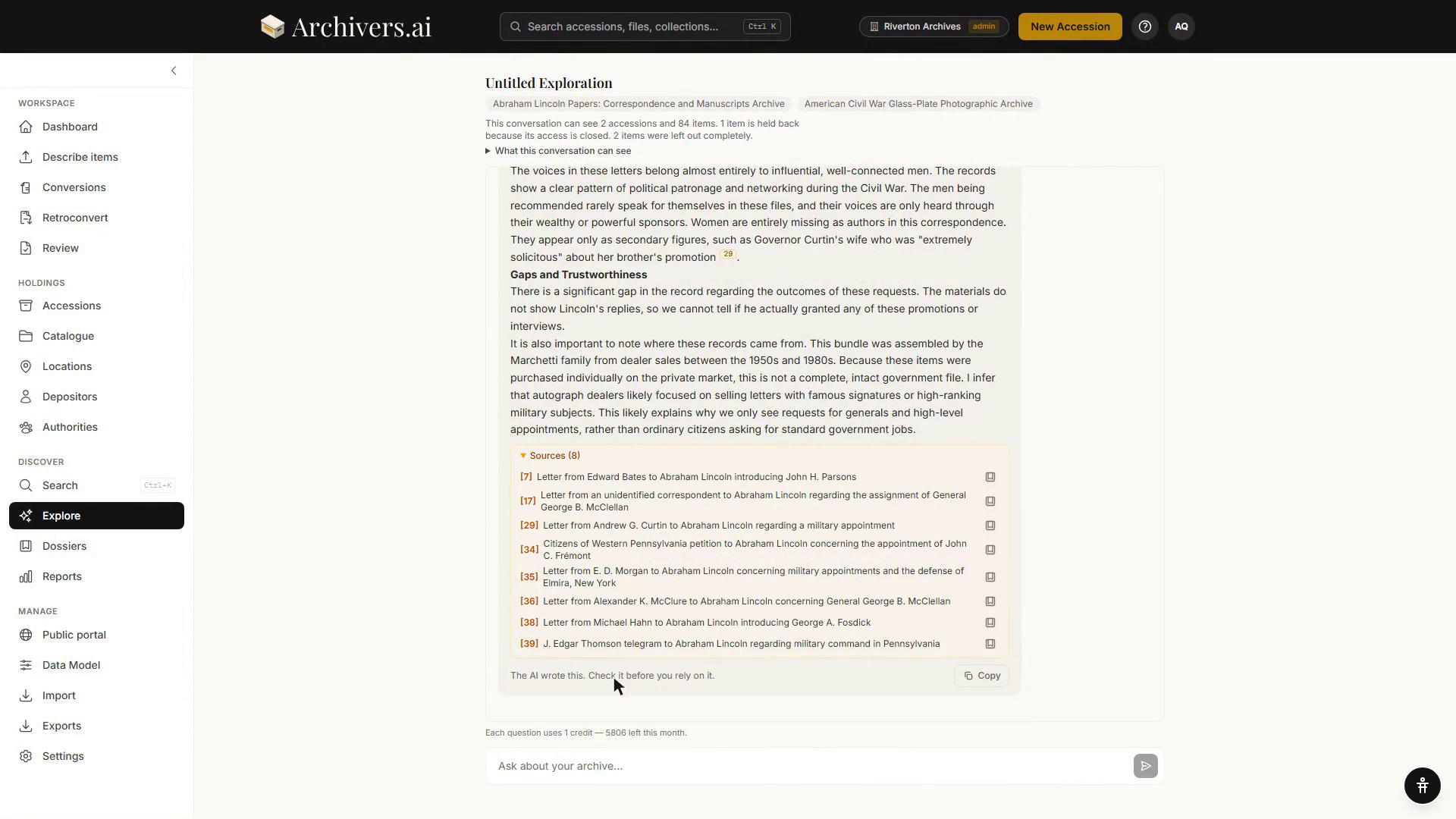
Three to five turns is usually enough to get from "what's in this dossier?" to "here's the specific paragraph I want to quote."
Last tip
The session's What are you looking into? note is doing a lot of work — every answer in the conversation keeps it in mind. It is set once, when the conversation starts, and can't be changed afterwards: the answers already given were given from it. So if your questions are landing wide, start a fresh conversation with a sharper note — be specific about what you're trying to find out.